|
 |
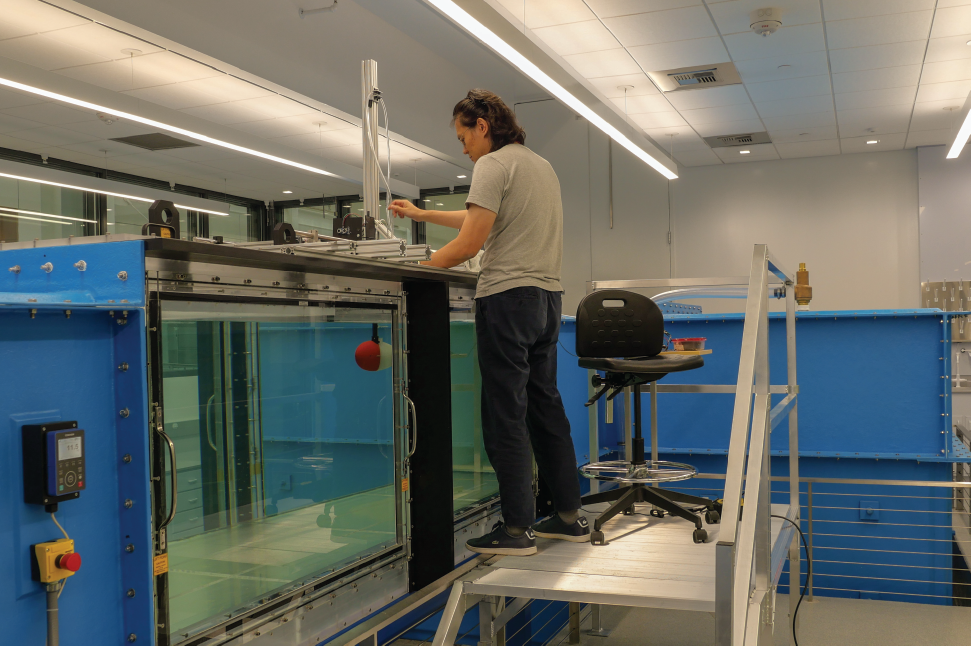
MATRIX Lab PhD Wei-Kuo Yen uses the MATRIX Lab's water tunnel to gather data |
|
We can learn a lot from fish.
University of Maryland (UMD) researchers are modeling and analyzing robotic fish movements in order to understand streamlined motion and energy savings. Their paper “Modeling inline oscillating foils using periodic conformal mapping,” published in the March 2025 edition of the journal Applied Ocean Research, explores how inline oscillating foils (or tailfins in the case of fish) move in the water, and how their spacing affects efficiency. Researchers logged their data using periodic conformal mapping, which simplifies complex flow calculations. They found that foils can improve efficiency when properly spaced amid swirling water patterns, or vortices. MATRIX Lab Assistant Research Engineer Dr. Wei-Kuo Yen is the paper’s lead author and has been using the MATRIX Lab’s water tunnel to gather data.
“This work is an important step in developing highly efficient, longer-lasting underwater systems that can explore dangerous or difficult to reach environments,” Dr. Yen said. “The water tunnel allows me to simulate the movement and flow of oceans and rivers in a controlled, indoor environment.”
Oscillating foils are often used to create more efficient autonomous underwater vehicles. Energy-saving movement allows these systems to operate longer without needing to recharge. Lower noise levels make them more ideal for stealth applications. Longer battery life and stealth are critical when exploring the deep sea, monitoring the environment, and conducting surveillance operations.
Oscillating foils serve as an alternative to traditional propulsion methods like propellers and jets. Traditional methods are used on systems like large ships when speed and power is necessary. However, these methods are often louder, less agile, and less energy efficient, making oscillating foils the better option in certain situations.
This work is part of a project led by UMD professor Derek Paley. UMD’s supercomputing resources were made available to conduct the project’s research. The work was supported by the Office of Naval Research.
Related Articles:
UMD Opens Outdoor Flight Laboratory to Advance Autonomy, Robotics
Building Bridges to Accelerate Innovation
Establish Research Partnerships at the MATRIX Open House
New Lecture Series Unites Experts to Solve Critical Challenges
New Initiatives Push Toward Safe & Reliable Autonomous Systems
Maryland Engineering Senior Among Aviation Week’s 2025 Class of 20 Twenties
Exploring the Future of AI and Addressing Trust Challenges
Inspired by Nature, Researchers Improve System Movement
Department Welcomes New Faculty Member John Martin
New algorithms for multi-robot systems in low communication situations
March 10, 2025
|


